
How to Take a Walk

In his essay “On Walking,” Henry David Thoreau uses blatant hyperbole to make his point: “We should go forth on the shortest walk, perchance, in the spirit of undying adventure, never to return – prepared to send back our embalmed hearts only as relics to our desolate kingdoms. If you are ready to leave father or mother, and brother and sister, and wife and child and friends, and never see them again – if you have paid your debts, and made your will, and settled all your affairs, and are a free man, then you are ready for a walk.” Thoreau himself confined his meanderings to New England and for most of his life remained in close proximity to his hometown of Concord. What he is speaking of here, though, is the spirit with which you should undertake a walk.
In the last couple of weeks, I have had a chance to compare a walk I consider a failure with a walk I consider a resounding success. This provoked musings about what factors contribute to an ideal walk.
My recent excursion to the Washington Park Arboretum got off the tracks early and never really recovered. I could have saved the day, but my unwise decisions doomed it. I started off on a muddy trail leading to boardwalks that should have taken me to beautiful offshore islands. However, when I reached the first boardwalk, I discovered that the trail was fenced off for repairs; just past the chain link fence and the “trail closed” sign I could see a portion of the walkway that had collapsed and was underwater. Undaunted, I made my way to the welcome center and took off on a path that I thought circled the arboretum. It turned out that instead it led to the other end of the closed trail I had already encountered, and I had to go back again to the welcome center if I wanted to commence an arboretum loop walk. By this time I had already walked for a few miles, and my legs and feet were getting sore. Rather than being satisfied with the interesting, albeit unplanned, excursion I’d already taken, I determined to finish what I had set out to that location to do: walk around the entire arboretum on the loop trail. This would involve walking for several more miles, and I was already tired. What I should have done was reschedule the arboretum walk for another day. Instead, I persevered. Perseverance can be a virtue, but sometimes, when it lapses into stubbornness, it can become a drawback. The arboretum trail is replete with breathtaking beauty, but most of the time all I could think about was my aching extremities and how much farther I had to go before I was done. My appreciation for my surroundings was diminished by the fatigue of overexertion. That’s no way to take a walk.
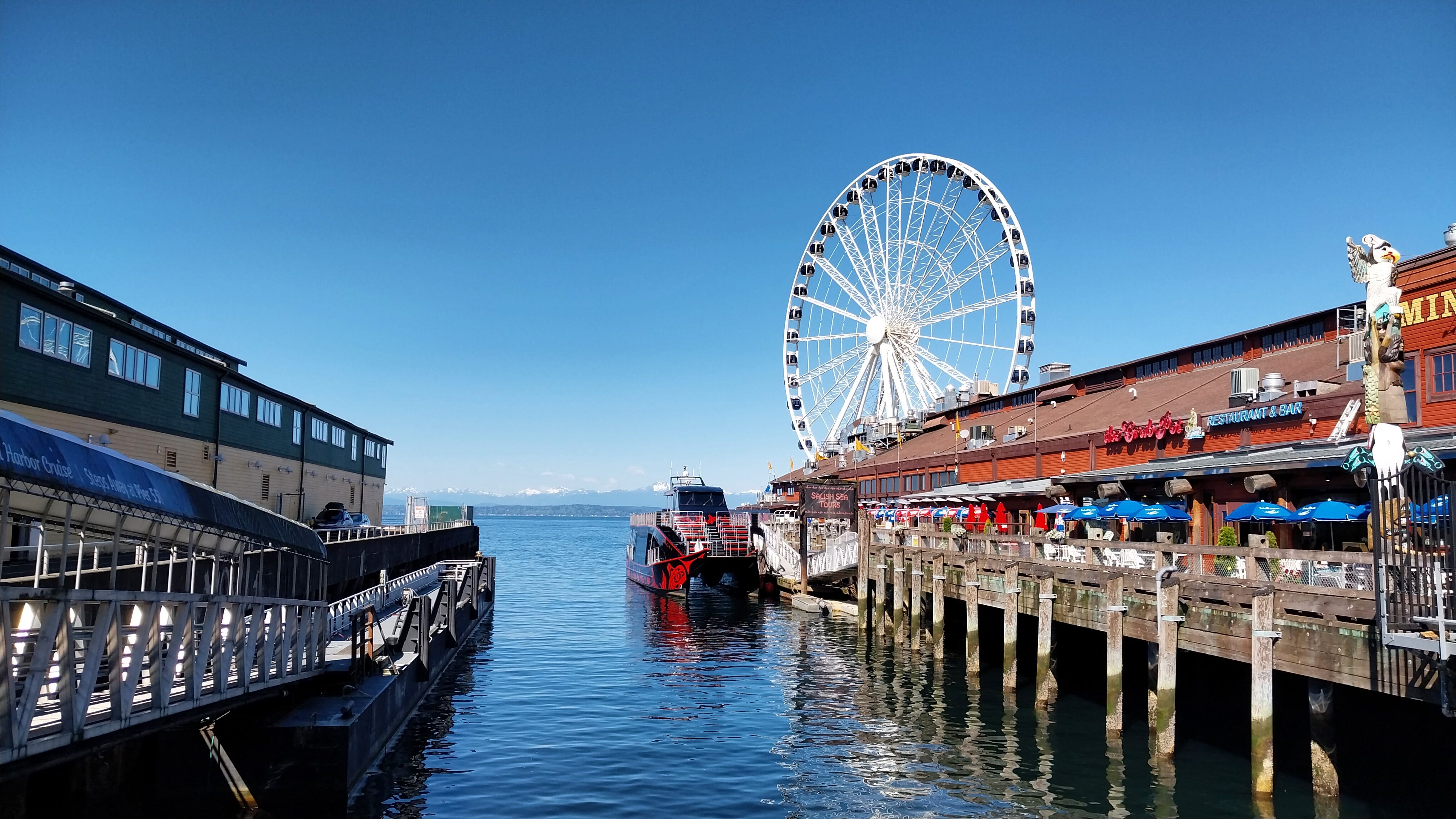
In contrast, the following week I took a walk along the downtown Seattle waterfront. I chose this location because it is one of my favorite perambulatory places; it is full of gorgeous sights and fascinating discoveries and distractions. I planned a route where I could get off the light rail at historic Pioneer Square, an area full of homeless indigents, stroll past them down to the waterfront, and explore the various attractions ensconced on the docks and piers between the Washington State Ferry Terminal and the Seattle Aquarium. On the way inland for my return journey via a different light rail station, I would be able to wander through the enigmatic Pike Place Market.
The day was cool and clear. The sky was deep blue, and the waters of Puget Sound were a different shade of deep blue. The waterfront was populated but not overcrowded. Across the sound, beyond the offshore islands, the Olympic Mountains gleamed with snow. I wandered through Ye Olde Curiosity Shop and a gallery of psychedelic three-dimensional art, both of which had the ambience of museums rather than retail outlets. I paused frequently to take in the breathtaking views, and in the spacious outdoor garden above the Seattle Aquarium’s new building, I sat for awhile in deep serenity and contemplated the tranquil waters with the islands and mountains beyond, the joy that the walk had thus far given me, and the perfection of the immediate moments of time I was then living.
So what makes a good walk? First of all, don’t be in a hurry. If your only motivation is to arrive at your destination, you are missing the point.
Pay attention to your surroundings. Keep your phone in your pocket unless you need to briefly pull it out to snap a few pictures. Tune in to where you are.
Know your limitations. You can challenge yourself to cover a certain distance, but be sure that you can handle that distance without undue trauma. It is okay to be tired, and a bit of pain in the feet and legs is to be expected, but remember that you are there to experience the joy of discovery and insight and of the open road, not to punish yourself. The adage “no pain, no gain” might be suitable for the gym, but it serves no purpose on a walk.
Have an escape plan. This is true especially if you initiate a lengthy walk you have not previously attempted. Go for as long as you feel inspired to go, and maybe a little longer – but feel free to stop if you get too tired or if you feel you’ve accomplished the day’s purpose.
Take your walks in surroundings that inspire. However, one man’s meat is another man’s poison, or as my literary mentor Harlan Ellison once put it, “One man’s nightmare is another man’s wet dream.” The surroundings on my walks have to be interesting, at least to me, but they don’t always have to be flamboyantly beautiful.
I should perhaps make a distinction here between necessary walks, for instance if you are going to work or to the supermarket, and walks specifically for the purposes of entertainment and edification. It is the latter I am referring to now. I usually take my significant walks on Saturday mornings. Sometimes I spend the whole week in preparation, planning where I will go, what transport I will take to get there, what I am likely to see, what shops and museums I can pause at, and so on. The great thing about walking is that it is something you can do almost anywhere. Simply get off your ass, pick a direction, and get started.